
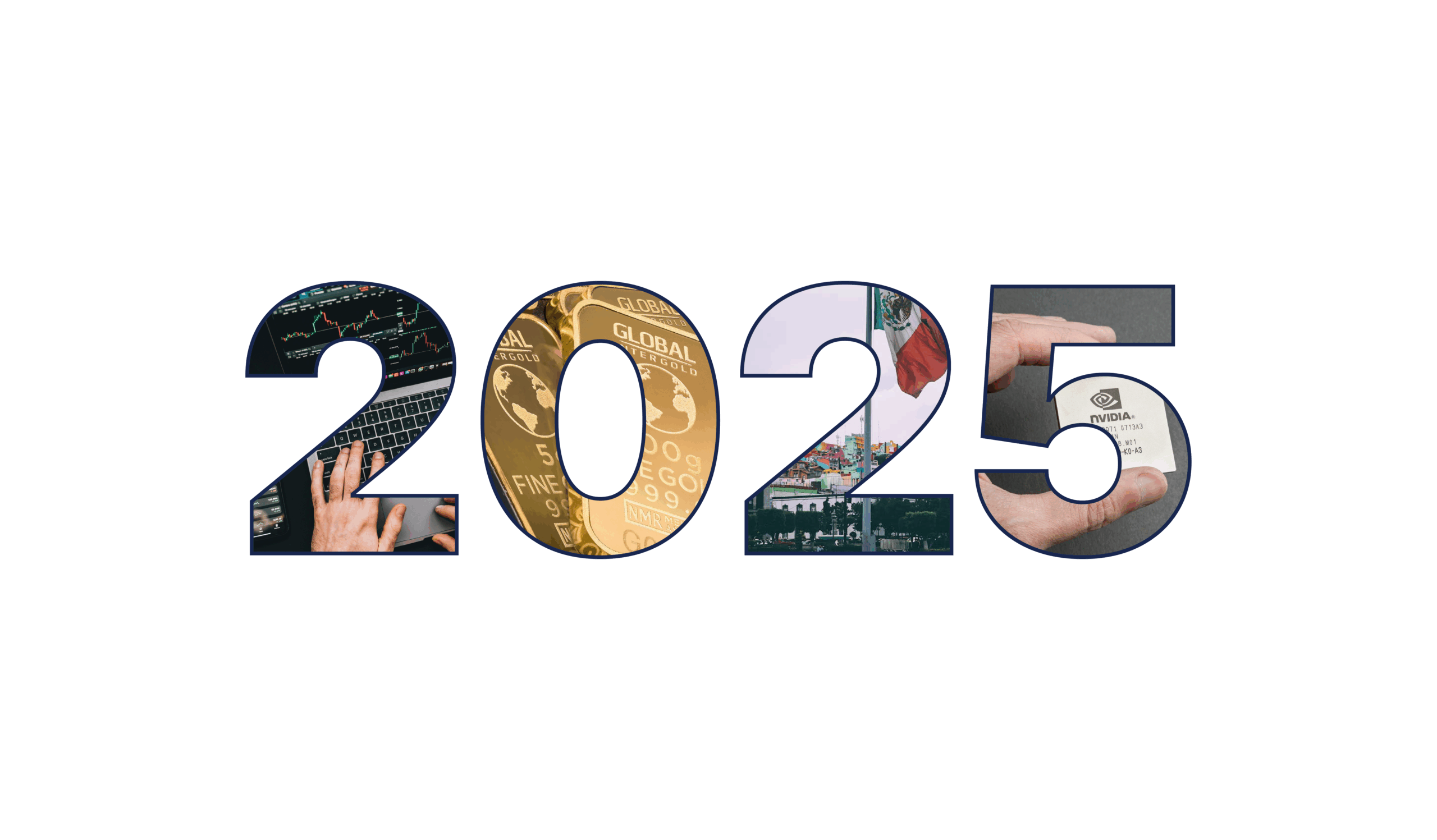
2025 Market Recap:
1. Central Banks
Central banks played a defining role in shaping the tone of 2025. Rather than bold, dramatic moves, policymakers focused on measured steps aimed at guiding their economies toward stability after several turbulent years.
- Federal Reserve: The year was marked by the Fed’s long-anticipated pivot. The Fed delivered its first rate cut of the cycle in September, to 4.25% and later it cut again in October to 4%.
- ECB: By June, as price pressures receded and economic momentum softened, especially in manufacturing-heavy countries, The European Central Bank cut its deposit rate to 2.00% as inflation drifted back toward target and growth softened.
- BoE: The Bank of England cut its interest rate to 4% in August, with two members already pushing for an even larger cut.
- BoJ: In January the rate increased from 0.25% to 0.5% and Kazuo Ueda claims they intend to resume this new pattern of increasing Japanese interest rates in the upcoming months.
All together, 2025 became a year where central banks sought not to surprise markets, but to steer them, adjusting policy carefully as global conditions evolved.
2. Currencies
Currency markets reflected these policy changes and the shifting macro landscape. Movements were notable, but not chaotic.
Dollar:
The US dollar entered 2025 still strong, with an index above 108, but as a rate cutting cycle began in response to softer data and moderating inflation, the dollar gradually lost some of its momentum entering December with an index at around 99.
Euro:
Euro started the year lower, at around 1.04 USD. It started rebounding in March and since June it has kept a momentum at around 1.16 USD. The currency’s stabilization could be a result of ECBs decision to keep its rates steady throughout the year.
Mexican peso:
One of the standout currencies of 2025 was the Mexican Peso. It strengthened considerably, moving from 20.8 per USD in January to below 18.30 by the end of this year. The country also kept a relatively low inflation and made impressive interest rate cuts, starting the year at 10% and ending at 7.25%
3. Indices: an AI year
Throughout 2025, US stock indices were strongly shaped by a small group of massive technology firms whose influence extended across the financial landscape. AI investment, innovation, and infrastructure remained the engines of optimism. Companies developing chips, running data centers, or providing the computing power behind machine learning continued to attract attention.
Because these trends are so dominant, the biggest companies in tech once again carried a large part of the market’s weight. Nvidia is the number one company in the S&P 500 and represents over 7% of its value, a remarkable concentration that illustrates just how central AI-related industries have become.
4. Commodities : a year written in gold
Commodities told a tale of contrasts in 2025.
One of the clearer stories of the year was that gold is the star of the show. There was a renewed strength in precious metals,but all paled in comparison to gold. Amidst geopolitical tensions in October the precious metal broke an impressive record: it shot past 4,200 USD per oz.
Other commodities had a bumpier ride. Oil, for instance, felt the weight of mixed demand signals, concerns over oversupply, and a broader sense that global growth may be slowing. Crude oil depreciated by -12.59% during 2025.
The divide was clear: while industrial and energy commodities were shaped by questions about growth, gold was shaped by renewed global interest as a safe haven.
Looking Back: 2025 was a year for the cautious and attentive
At first glance, 2025 delivered plenty of headlines : geopolitical tensions, shifting central-bank decisions, record-breaking gold prices, and major milestones in the world of AI. But when viewed from a broader perspective, it was not a year defined by dramatic market crashes or euphoric rallies.
Instead, 2025 was a year of careful navigation.
Central banks moved deliberately. Currencies adjusted gradually. Stock markets were carried by a handful of transformative companies. Commodities split between strength and struggle.
The overarching theme?
Stability was something that had to be actively managed, not simply assumed.


